How to Price Your Cafe Menu for Profit in the Philippines
Plenty of Philippine cafes are busy every afternoon and still barely break even at the end of the month. Usually the culprit is not slow sales. It is a menu priced on a feeling instead of on the numbers. If you set prices by glancing at the cafe next door and rounding to something that "feels okay," you are guessing with your own money. This guide walks you through a simple, repeatable way to cost your ingredients, set a healthy margin, and price your drinks and food so the cafe actually keeps something at the end of the day.
Start with the true cost of every cup and plate
Before you can price anything, you need to know what it actually costs to make. This is your cost of goods sold (COGS), and most owners undercount it. For one drink, add up every single thing that goes into the cup.
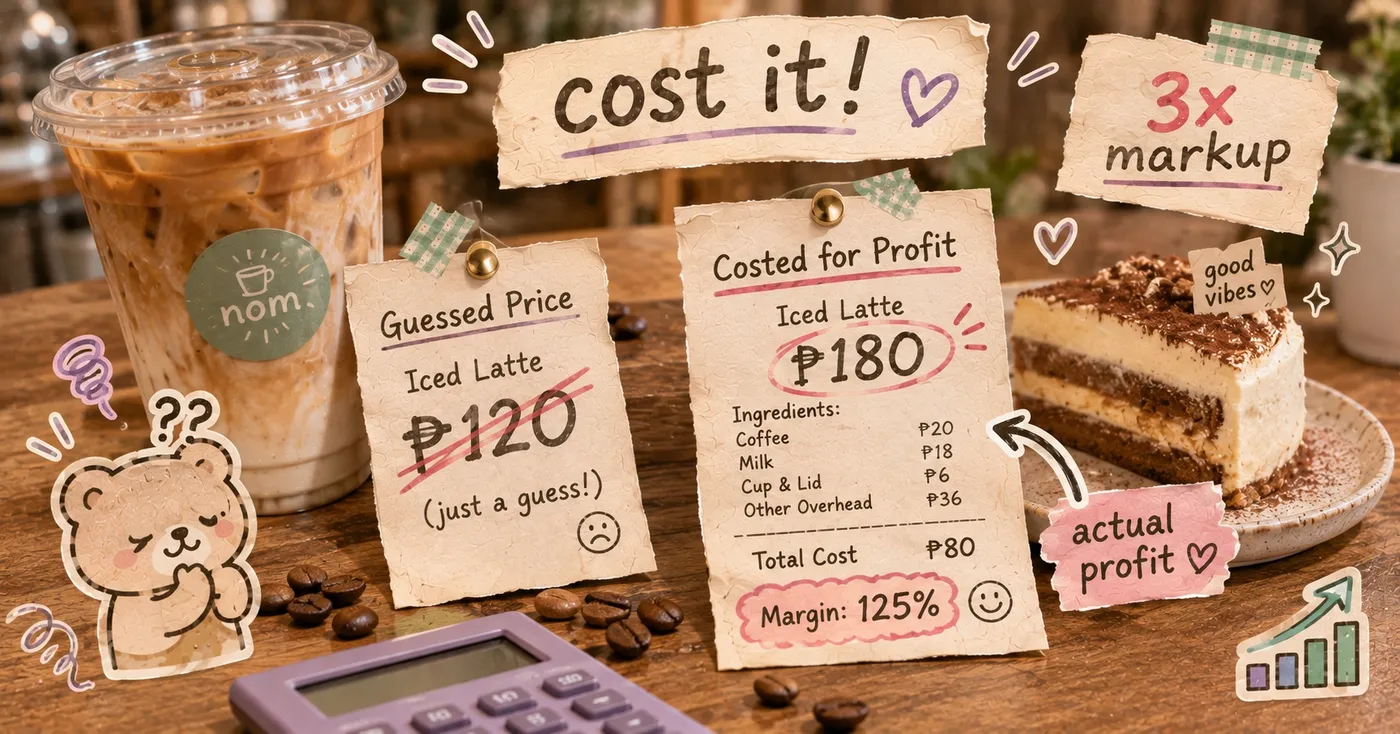
Take an iced cafe latte as a worked example. List the espresso shot (a portion of a kilo of beans), the milk, the cup, the dome lid, the straw, the ice, and the cup sleeve if you use one. Add them up and you might land somewhere around ₱28 to ₱40 in raw cost, depending on your supplier and bean. The exact number is yours to compute — the point is that you compute it per item, not as a vague monthly lump.
Do the same for a slice of cake, a rice bowl, or a pastry. Weigh your real portions once. A common leak is the barista who free-pours syrup or piles on extra cheese; if your recipe says 30ml and your staff pours 50ml, your costing is fiction. Standardise the recipe, then cost it.
Know your food-cost percentage target
Once you know the cost, the next question is what share of the selling price that cost should be. This is your food-cost percentage — COGS divided by the menu price. For most PH cafes, drinks tend to run a lower food cost (good margin) while food plates run higher.
A widely used rule of thumb is to keep food cost roughly in the 25% to 35% band, which means a target markup of around 3x to 4x on cost. If your iced latte costs ₱35 to make and you price it at ₱140, your food cost is 25% — healthy. If you price that same latte at ₱90 because "the place down the street charges ₱85," your food cost jumps to nearly 40% and your margin is paper-thin once rent and labour come in.
Drinks are usually where a cafe makes its real money, so guard those margins. Food and pastries often carry higher cost percentages, so treat them as basket-builders rather than your profit engine.
Don't forget the costs that aren't on the plate
Ingredient cost is only part of the picture. Your price also has to cover rent, electricity (espresso machines and chillers are hungry), staff wages, packaging, breakage, and the inevitable spoilage. A drink with a 25% food cost is not 75% profit — that 75% is what is left to pay for everything else and, hopefully, leave you something.
A simple discipline: after you set prices, estimate your monthly fixed costs and divide by your realistic number of paying customers. That gives you the overhead each sale must carry. If your prices do not comfortably clear ingredient cost plus that overhead share, you are running a hobby, not a business.
Price the menu so it sells, not just so it computes
Math gets you a floor price. Psychology gets you a price customers happily pay. A few tactics that work well in PH cafes:
- Anchor with a premium item. One slightly pricier signature drink makes your ₱140 latte feel reasonable by comparison.
- Use charm pricing where it fits. ₱145 reads softer than ₱150 on a menu, even though it is nearly the same.
- Bundle to lift the average order. A "drink plus pastry" combo at a tiny discount nudges the customer to add food they would not have ordered alone, raising your average order value without slashing margins.
- Add easy upsizes and add-ons. An extra espresso shot or an oat-milk upgrade is almost pure margin, and customers reach for it when offered cleanly at checkout.
When a customer orders through a Nom QR menu, those add-ons and customizations sit right next to each item, so the upsell happens on its own — no awkward upselling by your staff, no missed prompts during a rush.
Track what's working and adjust
Pricing is not a one-time event. Your bean supplier raises prices, milk gets more expensive, a drink quietly becomes your best seller. Review your menu every quarter. The owners who stay profitable are the ones who watch which items actually move and which ones just take up space on the board.
This is where seeing your own numbers matters. A dashboard that shows your best-selling items and your daily sales lets you spot the ₱140 latte carrying the whole month, and the slow pastry tying up fridge space and capital. Raise prices on the proven winners, retire the laggards, and re-cost anything where your supplier price has crept up.
Get the tools that make pricing easier
Good pricing is mostly good information: real ingredient costs, a clear margin target, and a live view of what sells. Nom gives PH cafe owners menu management with real-time availability, sales analytics, and QR ordering that surfaces add-ons automatically — and there is a free tier so you can start without risk. When you are ready, you can update prices across your menu in seconds and watch the effect in your numbers.
See how it fits your cafe on the Nom for Business page, or compare what each plan includes on the pricing page. Price with the numbers, and let your menu finally pull its weight.
Share this article