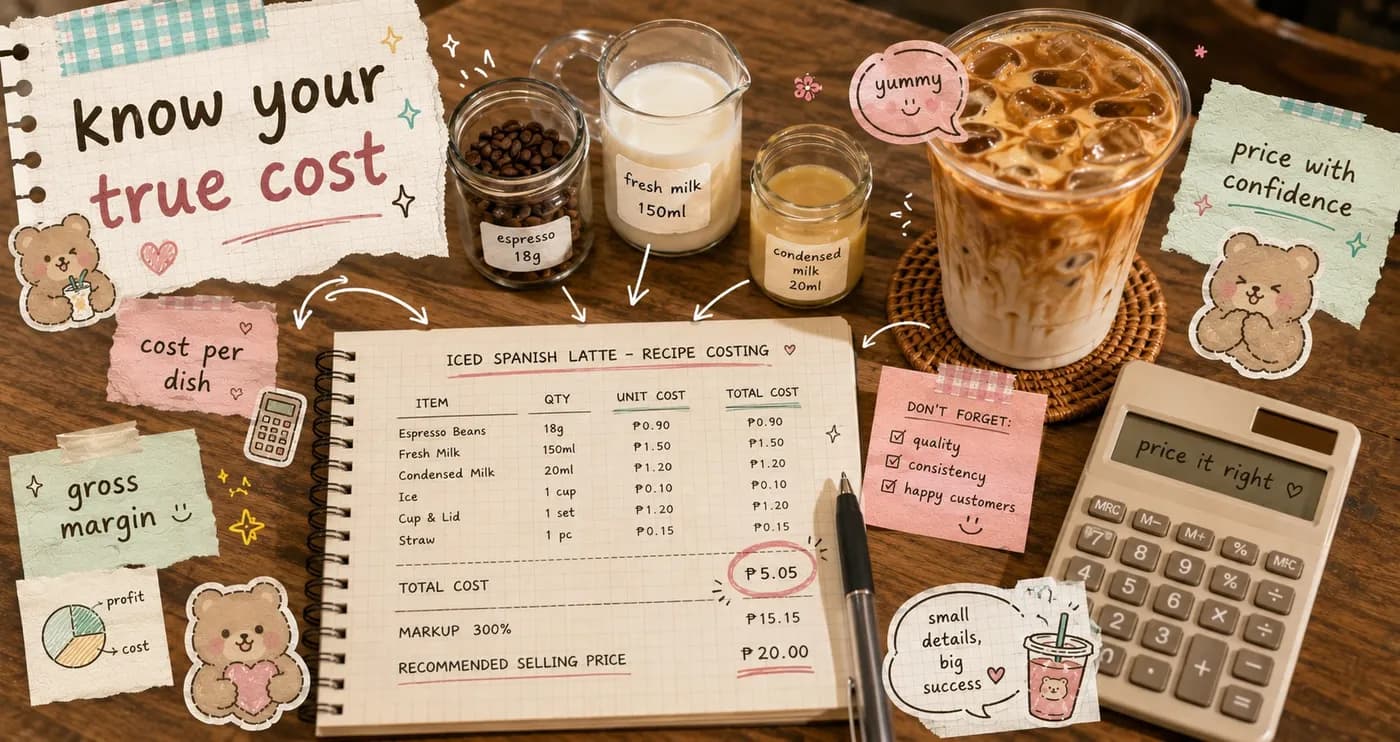
Recipe Costing for PH Cafes: Know Your True Food Cost
You can sell out every day and still go home with thin profit. The culprit is almost always the same: a menu priced by gut feel, where a few dishes quietly lose money on every order. Recipe costing fixes that. It is the practice of knowing exactly what each dish costs to make, so you price with confidence instead of crossing your fingers.
If you run a cafe, restaurant, or food stall in the Philippines, here is a practical walkthrough you can start this week.
What "food cost" actually means
Food cost is the peso value of every ingredient that goes into one serving of a dish. Not the rent, not the barista's wage, not the electricity for the espresso machine. Just the ingredients. Get this number right first, then layer the rest on top.
The two figures you want for every menu item are:
- Food cost per dish — the total ingredient cost for one serving.
- Gross margin per item — the selling price minus the food cost, shown as both pesos and a percentage of the price.
A common target in F&B is to keep food cost around a third of the selling price, leaving roughly two-thirds as gross margin. That ratio is a guide, not a rule. Some items will be higher, some lower. The point is to know the number for each one instead of guessing.
How to cost a single dish, step by step
Take one of your bestsellers and break it down. Say it is an iced spanish latte.
1. List every ingredient and its unit cost
Buy a 1kg bag of beans for a known price, and you can work out the cost per gram. Do the same for milk per milliliter, condensed milk per gram, ice, and the cup, lid, and straw. Yes, packaging counts as food cost in practice, because you cannot sell the drink without it.
2. Measure the actual portion used
Weigh your real shot. If your recipe pulls 18 grams of beans and pours 200ml of milk, use those numbers, not a rough guess. This is where most cafes leak money. Free pours and "tantsa lang" portions can swing your real cost by pesos per cup.
3. Add it all up
Sum the cost of beans, milk, condensed milk, ice, and packaging. That total is your true food cost for one iced spanish latte. Subtract it from your selling price and you have your gross margin in pesos. Divide the food cost by the price and you have your food cost percentage.
Do this once per dish and you will be surprised. The drink you thought was your money-maker might have the thinnest margin, while a quiet item on page two carries the whole menu.
Where PH cafes lose margin without noticing
Costing is not a one-time exercise. Prices move, and your margins move with them. Watch for:
- Supplier price creep. Beans, milk, and syrups inch up over months. A dish costed last year may be barely break-even today.
- Over-portioning. An extra pump of syrup or a heavier cheese hand, repeated hundreds of times, erodes margin you never see on a receipt.
- Add-ons priced too low. Extra shot, oat milk, pearls. If the add-on price barely covers its ingredient cost, you are doing more work for the same profit.
- Waste and spoilage. Prepped items that get thrown out at close are pure cost with zero sale attached.
None of these show up in your daily total. They only surface when you cost each dish and revisit the numbers every quarter.
Use your sales data to prioritize
You do not need to perfectly cost all 60 items on day one. Cost the ones that matter most: your top sellers by volume. A 5-peso margin gain on a drink you sell 80 times a day moves your bottom line far more than a 20-peso gain on something you sell twice a week.
This is where your point-of-sale and analytics earn their keep. With Nom, every order flows through one system, so your analytics show which items actually sell and how often. Pair that real sales mix with your costed recipes and you can see, at a glance, which dishes are both popular and profitable, and which are popular but barely paying for themselves.
That combination is the whole game. A bestseller with a weak margin is a fixable problem once you can see it. You might trim the portion, renegotiate a supplier, nudge the price up a few pesos, or build a combo that lifts the average order value without scaring customers off.
Turn costing into a habit, not a one-off
Make recipe costing part of your routine:
- Cost every new menu item before you launch it, never after.
- Recheck your top 10 sellers each quarter, or whenever a key supplier raises prices.
- Use real measured portions, and train staff to follow the recipe so your costed numbers stay true on the floor.
- Review the sales-versus-margin picture monthly so menu decisions are based on evidence, not hunches.
Knowing your true food cost is what separates a cafe that survives from one that quietly builds profit. You keep your prices fair for customers and your margins healthy for the business, no commission skimmed off every order, no guesswork.
Want the sales side handled so costing is easy? Nom gives PH cafes a live orders board, real menu analytics, and instant availability toggles in one place. See how it fits your shop on our for business page, or check the plans on pricing.
Share this article