How to Choose the Right Cafe Location in the Philippines
Location is the one cafe decision you cannot tweak later. You can reprice your menu, retrain your baristas, and redesign your QR ordering flow in an afternoon. A bad lease, you live with for years. Whether you are opening your first kapehan or scouting a second branch, picking the right spot is the highest-leverage choice you will make. Here is a practical, Philippine-specific way to evaluate a location before you sign anything.
Read the foot traffic before you trust your gut
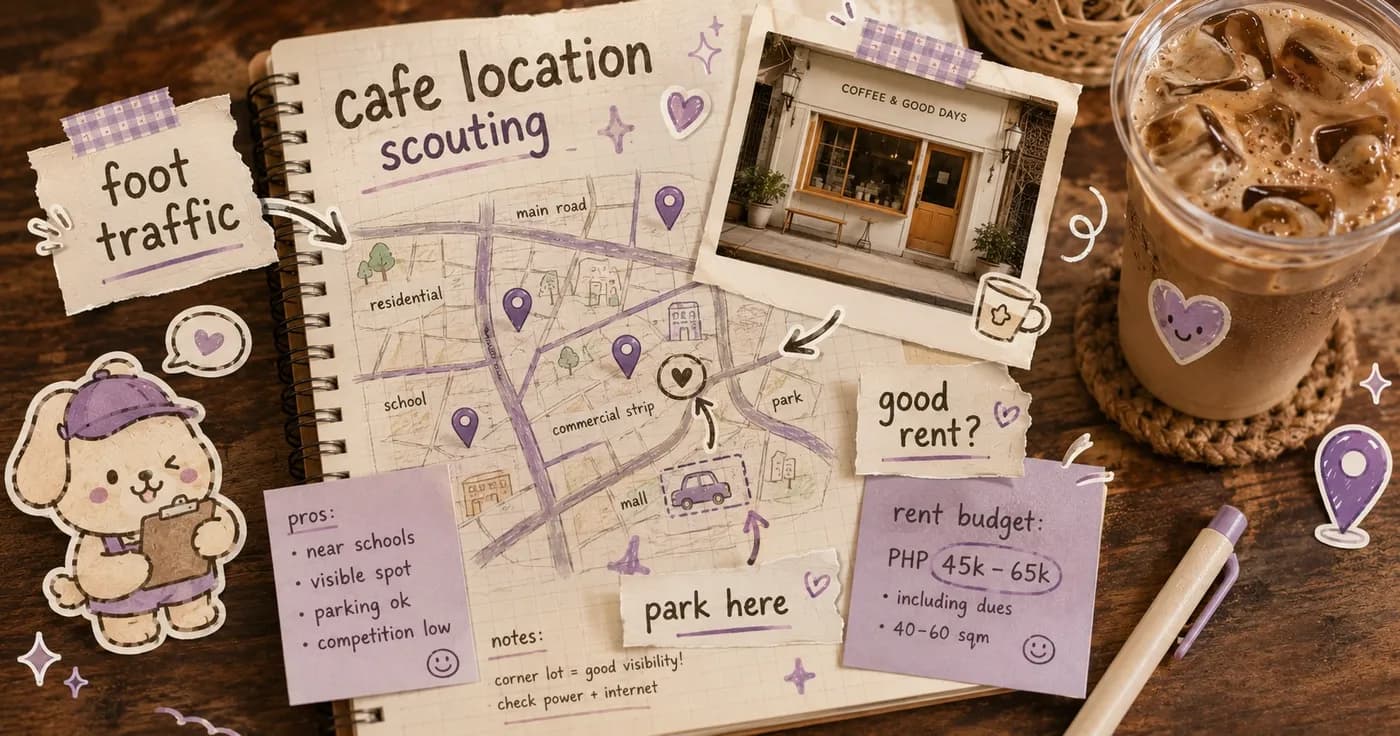
A spot that feels busy on a Saturday afternoon can be a ghost town on a Tuesday morning. Before falling in love with a unit, count the actual people walking past it at different times.
- Visit at least three times across a weekday morning, a weekday lunch, and a weekend afternoon. Stand outside and literally count heads for ten minutes each.
- Match the crowd to your concept. A grab-and-go espresso bar near a BPO or office tower wants weekday morning rush. A cozy study cafe near a university wants afternoons and exam season. A weekend brunch spot lives off Saturdays and Sundays.
- Notice direction and pace. People speed-walking to an MRT station rarely stop for a sit-down latte, but they might grab a quick iced coffee. People strolling a village commercial strip are in browse mode and will linger.
Foot traffic is your raw material. Everything else is about converting it.
Run the rent math, not the rent feeling
The prettiest unit on the strip is often the most expensive, and rent is the cost that never sleeps. A useful PH rule of thumb is to keep monthly rent within a sustainable share of your projected sales, not your dream sales.
- Ask for the all-in number. Beyond base rent, mall and commercial spaces often add CUSA (common use service area) dues, association fees, aircon charges, and a percentage-of-sales clause. Get every line item in writing.
- Clarify the lease term and escalation. Many PH leases run two to three years with a yearly increase. Know the percentage before you commit, and ask about the security deposit and advance.
- Factor the build-out. A bare shell needs electrical, plumbing, grease trap, and exhaust. A former food space might already have these, saving you months and a large chunk of capital.
One advantage worth noting: a QR-based ordering setup needs no expensive POS hardware or terminal, so your fit-out budget can go to the things customers actually see. That matters most in a high-rent unit where every peso of capex counts.
Don't ignore parking and how people actually arrive
How your customers get to you shapes who comes and how often.
- Car-dependent areas like village commercial centers and suburban strips need real, easy parking. If guests circle the block twice, they leave.
- Transit and walk-up areas near stations, schools, and offices live on visibility and a quick entry, not parking.
- Rider access matters now. A spot that is easy for a delivery rider to pull up, park, and grab a clearly labeled order keeps your delivery channel smooth.
Walk the last 50 meters to the door yourself. If it is confusing, hot, or hidden, your customers will feel it too.
Match the neighborhood to your concept and price
A ₱180 specialty pour-over thrives near offices and upscale villages; it struggles beside a palengke where a ₱60 cup wins. The neighborhood sets the ceiling on what people will happily pay.
- Study the daytime population. Who is actually here from 8am to 8pm? Office workers, students, residents, tourists, or churchgoers each create different peak hours and average spend.
- Check the surrounding anchors. A nearby gym, co-working space, school, or supermarket creates steady, predictable trips. Reliable neighbors beat a one-time event crowd.
- Confirm the vibe fits your brand. A minimalist matcha bar feels right in a design-forward district and out of place in a hardware row.
Size up the competition honestly
Competitors next door are not automatically bad news. A street already known for coffee draws people who came specifically to drink coffee.
- Map who is within a 5-minute walk. Note their price points, their busiest hours, and the one thing they do not offer.
- Find your wedge. If three nearby shops are loud and crowded, a quiet study cafe with reliable outlets wins. If everyone is slow at peak, fast self-service ordering becomes your edge.
- Let speed be your differentiator. When the line next door is long, letting guests scan, order, and pay from their seat without queueing turns your spot into the convenient choice, even in a saturated area.
Turn the location into a decision you can verify
You do not have to guess forever. Once you are running, your analytics tell you whether you read the spot correctly: which hours actually peak, what your average order value looks like, and how busy each part of the day gets. That same picture helps you decide where a second branch belongs.
The best location decision is the one you can defend with a notebook full of head counts, an honest rent spreadsheet, and a clear sense of who walks by. Get those right, and the rest of your cafe has room to win.
Ready to open or expand with less hardware and clearer numbers? See how Nom works for cafe owners or compare plans and pricing to find the fit for your spot.
Share this article