How Much Does It Cost to Open a Cafe in the Philippines?
Opening a cafe in the Philippines is one of the most rewarding small businesses you can build, but the startup numbers can feel overwhelming when you are staring at a blank spreadsheet. The honest answer to "how much will it cost?" is: it depends on your space, your menu, and how lean you are willing to start. This guide breaks down the real cost buckets so you can plan with eyes open, and shows where a tight-budget founder can trim without cutting corners that matter.
The Five Cost Buckets Every PH Cafe Owner Faces
Before you fall in love with a corner lot or a fancy espresso machine, group your startup costs into five buckets. Almost every peso you spend before opening day lands in one of these:
- Space — rent, deposit, advance, and renovation or fit-out.
- Equipment — your machine, grinder, fridge, furniture, and POS.
- Permits — the legal paperwork that keeps you open.
- Inventory — opening stock of beans, milk, syrups, cups, and food.
- Staff — hiring, training, and the first month of salaries.
Get a rough figure for each, add a buffer, and you have a startup budget. The mistake most first-timers make is funding buckets one and two generously, then running dry on inventory and staff before the cafe has even found its rhythm. Plan all five together.
Space: Your Biggest and Trickiest Line Item
Location is usually the single largest cost, and it is where Metro Manila and a quiet provincial town diverge most. A small kiosk inside an existing food hall costs a fraction of a standalone shop on a busy commercial strip. Landlords here typically ask for two to three months deposit plus one to two months advance, so you are paying several months of rent before you sell a single cup.
Renovation is the wildcard. A bare shell needs plumbing, electrical, tiling, counters, and signage, while a former cafe or restaurant space may already have the bones you need. A founder opening a 30-seat sit-down cafe will spend far more on fit-out than someone running a grab-and-go window beside a co-working space.
Where to start lean
Consider a small footprint first. A counter-service or takeout-focused cafe needs less floor area, fewer chairs, and a smaller crew. Many successful PH cafes opened as a tiny window or a shared kitchen stall, proved the concept, then expanded. Less space also means less to clean, staff, and pay rent on every month.
Equipment: Buy for Volume, Not Vanity
Your espresso machine and grinder will be the heart of the operation, and prices range from entry-level units to high-end imports that cost as much as a small car. Add a refrigerator, a blender for frappes, a water filter, work tables, and front-of-house furniture. Then there is the often-forgotten part: how customers order and pay.
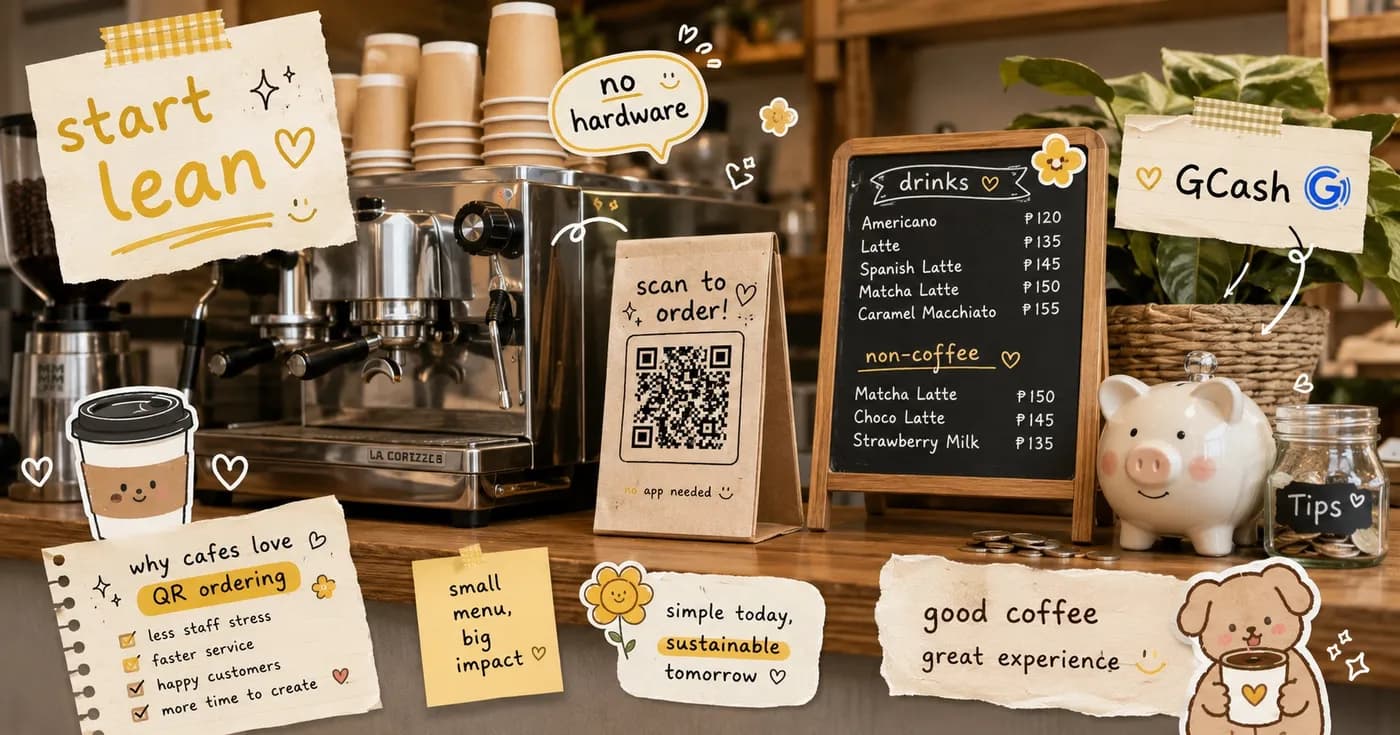
This is where you can save real money. A traditional setup means a cash register, a card terminal, and sometimes a separate ordering screen. With Nom, customers scan a QR code at the table or counter, browse your menu on their own phone, customize their order, and pay, no extra hardware to buy. Payments come in through GCash, Maya, QRPH, or cash, and there is no commission taken per order.
Where to start lean
Buy the machine your volume actually needs, not the one that looks impressive on Instagram. Secondhand commercial equipment in good condition is common and often half the price. And because the menu and ordering live on the customer's phone, you skip buying tablets, kiosks, and a printed-menu reprint every time you change a price.
Permits: Boring, But Non-Negotiable
You cannot legally operate without the paperwork, and rushing this stage causes painful delays. At minimum you will register your business name (DTI for a sole proprietorship, or SEC for a corporation), secure a Barangay clearance and Mayor's or business permit from your LGU, register with the BIR for your TIN and official receipts, and pass sanitary and fire safety inspections. Food handlers will need health certificates.
Budget for filing fees, plus the time it takes to line up. A practical tip: ask your barangay and city hall for their exact checklist on day one so you are not making five separate trips. The cost here is modest compared to space and equipment, but skipping a step can shut you down right after you open.
Inventory and Staff: The Costs That Repeat
Opening inventory is your first stock of beans, fresh milk, syrups, pastries, cups, lids, straws, and napkins. Buy enough to look full and serve a busy weekend, but not so much that fresh items spoil. Track what sells and reorder tighter as you learn your patterns.
Staff is the cost that quietly repeats every payday. Even a small cafe usually needs a barista and a service or kitchen hand, plus you on the floor. Budget for the first one to two months of salaries before the cafe is profitable, because almost no cafe breaks even in week one.
Where to start lean
Keep the opening menu short. A focused list of drinks and a few food items is cheaper to stock, easier to train staff on, and faster to serve. Use your sales data to add items that customers actually ask for, instead of guessing. When you can toggle an item's availability the moment you run out, you avoid the awkward "sorry, wala na po" after the customer has already ordered, and you protect every peso of margin.
A Realistic Way to Think About the Total
Add your five buckets, then add a contingency buffer of at least one to two months of operating costs on top. Cafes that fail often do not fail because the coffee was bad; they fail because they ran out of cash before customers became regulars. Your goal is to open with enough runway to survive the slow early weeks while word spreads.
Starting lean is not about being cheap. It is about putting money where customers feel it, the quality of your drinks and the speed of service, and saving everywhere they do not, like hardware you can replace with a QR code and a phone. A leaner launch also means you reach break-even sooner and keep more of every sale.
When you are ready to set up ordering and payments without buying extra equipment, you can start on a free plan built for cafes serving up to around ten daily customers, then move up to a paid plan only as you grow. There is no lock-in and you can cancel monthly. Explore what fits your cafe on our pricing page, or see the full owner toolkit on our for business page. Plan smart, open lean, and let your coffee do the talking.
Share this article